

Venice Without the Crowds
Venice Without the Crowds
Everyone knows Venice is crowded. Almost nobody acts on the second half of that sentence, which is that it is crowded in a pattern by month, by hour, by about four hundred metres of the city and that the pattern is completely predictable.
Between the middle of September and the end of November, that pattern breaks. The cruise season thins, the day-visitor access fee is no longer in force, the light goes low and gold, and the fog begins. It is, by a distance, the best Venice of the year. It is also the version almost nobody asks us for.
The season, month by month
September. Still warm, still full, but the summer crush is over by the second week. Evenings are long and the water is warm enough that the city smells of summer rather than autumn. Good for a first visit; not yet quiet.
October. The turn. Fewer visitors each week, restaurants get their tables back, and the light drops to the angle that made every painter who came here stay. Mid-October to mid-November is the window we recommend most often.
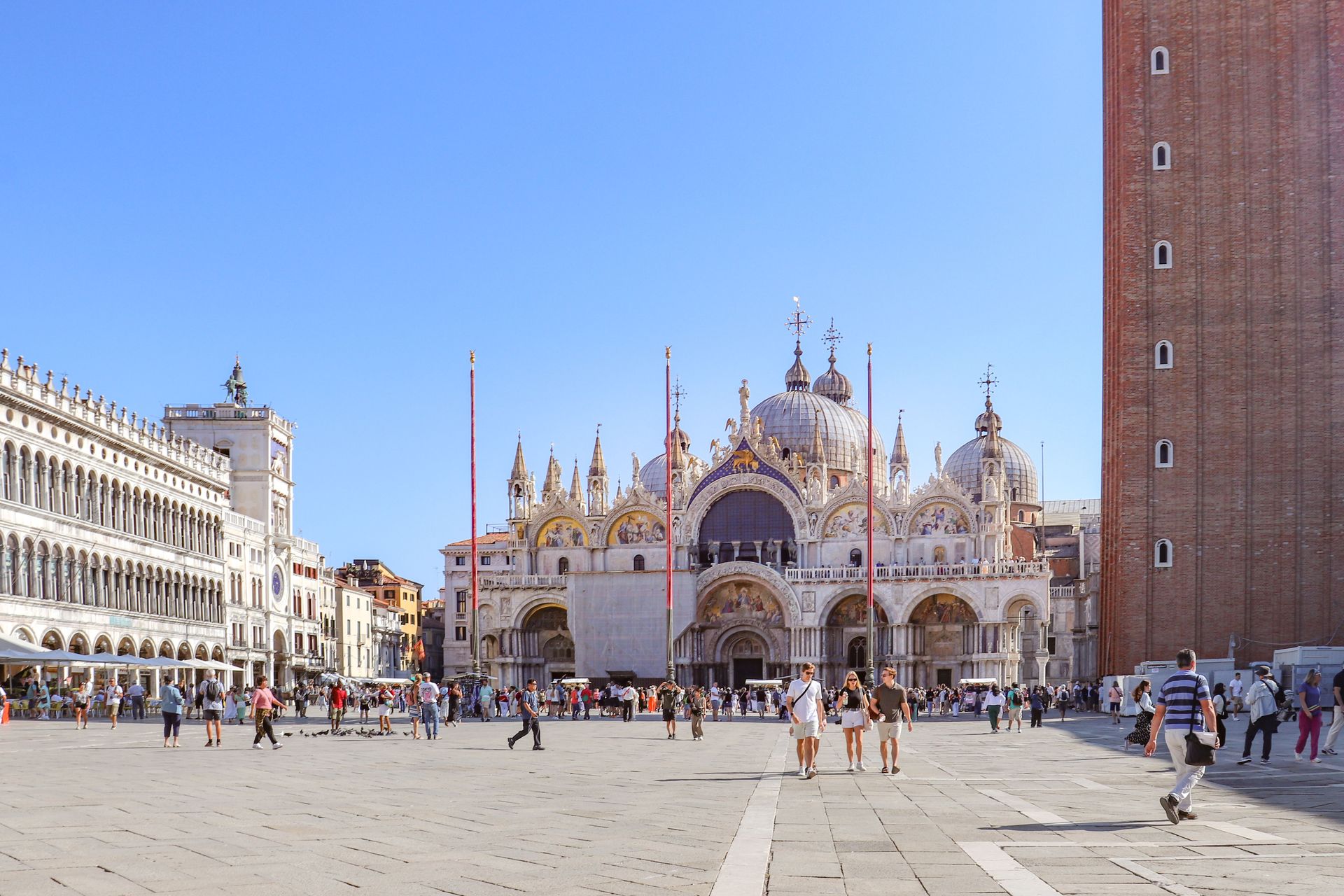
November. Cold mornings, early dark, and fog. The city empties to something close to how it lives. This is when a private house can be arranged, when a restaurant will hold a table, and when San Marco at eight in the morning belongs to about nine people. It is also the month people cancel because they have read about acqua alta which is a mistake, and one worth explaining.
The access fee does not apply in autumn
This is a small, precise thing that changes trip planning and almost nobody has it right.
Venice charges day visitors an access fee, but only on selected days: in 2026 it runs from 3 April to 26 July, across sixty non-consecutive days. From the end of July onward — and therefore across the whole autumn there is no fee at all.
And in any season, guests staying overnight in the municipality are exempt. They do still have to register on the city's portal to get the exemption QR code, which is the part people miss and which we handle before arrival rather than at a turnstile with luggage.
What a "private palazzo" actually is
Here the gap between what is advertised and what exists is wide enough to be worth naming.
Most of what is sold as a private palazzo in Venice is an event venue: a piano nobile with a catering kitchen, rented by the hour, with a rate card. There is nothing wrong with these some are magnificent, and for a dinner of thirty they are exactly right. But they are venues, and they feel like venues.
The other kind is a house. A family still lives in part of it, the paintings on the walls belong to people whose surnames are on them, and it is not for hire. These open occasionally, for a small number of guests, because someone who has known the family for twenty years asked on their behalf and vouched for how the guests will behave.
We can arrange the second kind. What we cannot do is promise a specific house on a specific evening, because the answer is often no, and a family that says no in October may say yes in February. Anyone who guarantees you a named palazzo months ahead is selling you the first kind and describing the second.
The Biennale, and how not to do it badly
The 61st Art Biennale, In Minor Keys, runs from 9 May to 22 November 2026 across the Giardini and the Arsenale, with a further section at Forte Marghera in Mestre. From 29 September the hours shorten to 10:00–18:00, and it is closed on Mondays.
Three practical things.
The Giardini and the Arsenale are two separate days, not two halves of one. People try to do both between lunch and dinner, and see neither. The Arsenale in particular rewards a slow morning.
The last three weekends before it closes are the busiest of the entire run the art world arrives at once. If you are coming in November, go on a Tuesday or Wednesday.
And the national pavilions in the Giardini are not the whole thing. Some of the best work of any Biennale sits in collateral events scattered across the city, in buildings that are otherwise closed all year. Those are worth a guide who knows which ones are good this time, because half of them are not.
Acqua alta is not what you think
High water is the reason people avoid November, and the reason is based on photographs rather than on how it works.
Acqua alta is a tide, not a flood. It is forecast days ahead, it peaks for two or three hours, and it drains. On the mornings it happens, raised walkways go up on the main routes, the shops put their boards in the doorways, and life continues in rubber boots. The city has done this for a thousand years and is unbothered.
Since the MOSE barriers came into service the highest tides are also increasingly held back, which has changed November considerably. What remains is the ordinary version: a wet hour at San Marco, ankle-deep, at a predictable time.
Pack the boots. Move the morning by ninety minutes. That is the whole adjustment.
Where the crowds actually are
Venice's crowding is startlingly local. The great majority of visitors occupy a corridor running from Piazzale Roma and the station to the Rialto and on to San Marco, between roughly ten in the morning and four in the afternoon.
Step two streets off it and the city is quiet at any hour of any month. Cannaregio north of the Strada Nova, the eastern half of Castello beyond the Arsenale, the far end of Dorsoduro, and the whole of the Giudecca are essentially empty. A good day in Venice is planned around this fact and not around a list of sights.
The corollary: San Marco is worth seeing early. At eight in the morning the basilica's mosaics are lit and the square has more pigeons than people.
Planning it
How long. Three nights minimum. Venice punishes the day trip and rewards the second evening, when you stop navigating and start recognising things.
When to book. Autumn Venice is not high season, but the small number of houses and tables worth having are booked by people who come every year. For October and November, six to eight weeks out is comfortable; the final Biennale weeks are tighter.
Getting there and around. A private water taxi from the airport is the right arrival it is the only way to enter the city from the water, and it matters. After that, walk. The taxi is for luggage, for late returns, and for reaching the islands; it is not a way to see Venice.
What to expect of the weather. Ten to sixteen degrees, rain, and fog that burns off by mid-morning. Bring a proper coat and shoes you can walk eight kilometres in, because you will.
Autumn Venice needs less arranging than most places and better arranging than most people give it. The difference between a good week and a remarkable one is almost entirely a matter of hours and doors: being in the right sestiere at the right time, and knowing which handful of houses might open.
If Venice is on your list before the Biennale closes on 22 November, tell us what you have in mind.
Related: White Truffle Season in the Langhe the other Italian autumn worth arranging carefully.
Common questions
When is the best time to visit Venice without the crowds?
Mid-October to mid-November. The summer and cruise traffic has gone, the day-visitor access fee is not in force, restaurants and private houses become available, and the light is at its best. September is quieter than August but still busy; late November is the emptiest of all.
Do I have to pay the Venice access fee?
Not in autumn. In 2026 the fee applies only between 3 April and 26 July, on sixty selected days. Guests staying overnight within the municipality are exempt in any season, but must still register on the city's portal to obtain the exemption QR code.
Is acqua alta a reason to avoid November?
No. Acqua alta is a tide, not a flood: it is forecast days in advance, peaks for two or three hours and drains. Raised walkways go up on the main routes and the city carries on. Since the MOSE barriers came into service the highest tides are increasingly held back. Bring boots and shift the morning by an hour and a half.
Can you actually visit a private palazzo in Venice?
Yes, but two different things are sold under that name. Most are event venues rented by the hour. A small number are houses where a family still lives, which open occasionally for a few guests when someone who knows the family asks on their behalf. The second kind cannot be guaranteed on a given date, and anyone promising a named palazzo months ahead is offering the first.