

White Truffle Season in the Langhe
White Truffle Season in the Langhe
The season has dates, and they are public. The white truffle harvest opens across Piedmont on 1 October and closes on 31 January. The Fiera Internazionale del Tartufo Bianco d'Alba its ninety-sixth edition runs from 10 October to 6 December 2026.
Those dates are the least useful thing to know about the season.
What matters is that between the first week of October and the first week of December, a small stretch of Piedmont becomes one of the most difficult places in Europe to arrange well. Twelve hundred people descend on a market hall in Alba on a Saturday morning. The best tables in Barolo and La Morra close their books in September. And the trifolau the truffle hunter who might actually take you into a wood at five in the morning is not on any booking platform, because he does not want to be.
The season has a shape
Not all of the season is the same season.
Early October. The harvest has just opened after September's mandatory rest period. The first tubers come out of the ground, and they are expensive scarcity, not quality, sets the price in the first two weeks. If the summer was dry, the early truffles are small and the aroma is thin. This is the worst value of the year and the most photographed.
Late October to mid-November. The centre of the season. Autumn rain has usually arrived, the tubers are larger and more fragrant, and the vineyards have turned. This is when the Langhe are at their best and also at their fullest: the fair is running every weekend, and Alba is not a quiet town on a Saturday in November.
Late November to early December. Fewer visitors, colder mornings, and the fog that gives the region its particular silence. The truffles are excellent. The fair closes on 6 December. For anyone who has been to Piedmont before and did not enjoy the crowds, this is the window we recommend most often and the one almost nobody asks for.
What a truffle hunt actually is
It is worth being direct about this, because the gap between what is sold and what exists is wider here than almost anywhere else in Italian travel.
A real search happens before dawn or after dark, in cold and usually in mud. It is led by a dog a mongrel more often than a breed, trained from a puppy and by a man who has walked those particular woods for thirty years and will not tell you where they are. He works by scent and by memory. When the dog stops, he digs with a small pickaxe, takes the tuber, and puts the soil back exactly as he found it. The whole thing may produce nothing. Frequently it produces nothing.
Most of the "truffle hunting experiences" available to book online are not this. They are staged in a fenced wood, at a civilised hour, with a truffle placed in advance so that the group is not disappointed. There is nothing dishonest in that arrangement if it is described as what it is, it is a demonstration, and children love it.
But if what you want is the real thing, understand what you are asking. A trifolau does not bring strangers into his ground because a hotel called. He does it because someone he trusts asked him, and because he decides you will not talk about where you went. We can arrange it. We cannot arrange it for next Tuesday, and we cannot promise you will find anything.
That second sentence is the honest one, and it is the reason the first is true.
The fair, and why we mostly work around it
The Fiera del Tartufo is a genuine institution, not a tourist invention. The Mercato Mondiale del Tartufo Bianco is where the tubers are actually traded and judged, and walking it with someone who can tell you why one truffle costs three times another is a real education. The masterclasses and tasting workshops are well run. The events at the Castello di Roddi are worth a morning.
The problem is Saturday and Sunday. On weekend days in late October and November, Alba receives more visitors than its centre comfortably holds, and the experience becomes queueing.
The correction is simple and almost nobody makes it: go on a Tuesday or a Wednesday. The market is open, the traders have time to talk, the restaurants have tables, and the town returns to being a town. We build the fair into a weekday and leave the weekends for the hills.
What else is happening at the same time
October in the Langhe is not only about truffle, and a trip built on truffle alone will feel thin by the third day.
The nebbiolo harvest finishes in the first days of October, which means the cellars in Barolo, Barbaresco, Serralunga d'Alba and La Morra are at their busiest and their least available. A visit during harvest week is not a normal tasting; it is watching people work, and it requires asking properly and in advance. Done well, it is the best hour of the trip. Done badly, it is an interruption to someone's year. Our private wine tastings in the Langhe are arranged around what the producer is actually doing that week, not around a fixed schedule.
From roughly the third week of October the vineyards turn nebbiolo to yellow and copper, dolcetto to red and the ridge roads between Barolo, Monforte and Serralunga become the reason people come back to Piedmont for a second time.
And there is the fog. From November it settles into the valleys at night and burns off around ten in the morning, leaving the villages on the ridges above a white sea. It is the single most beautiful thing in the region and it cannot be scheduled.
Where the truffle is actually eaten
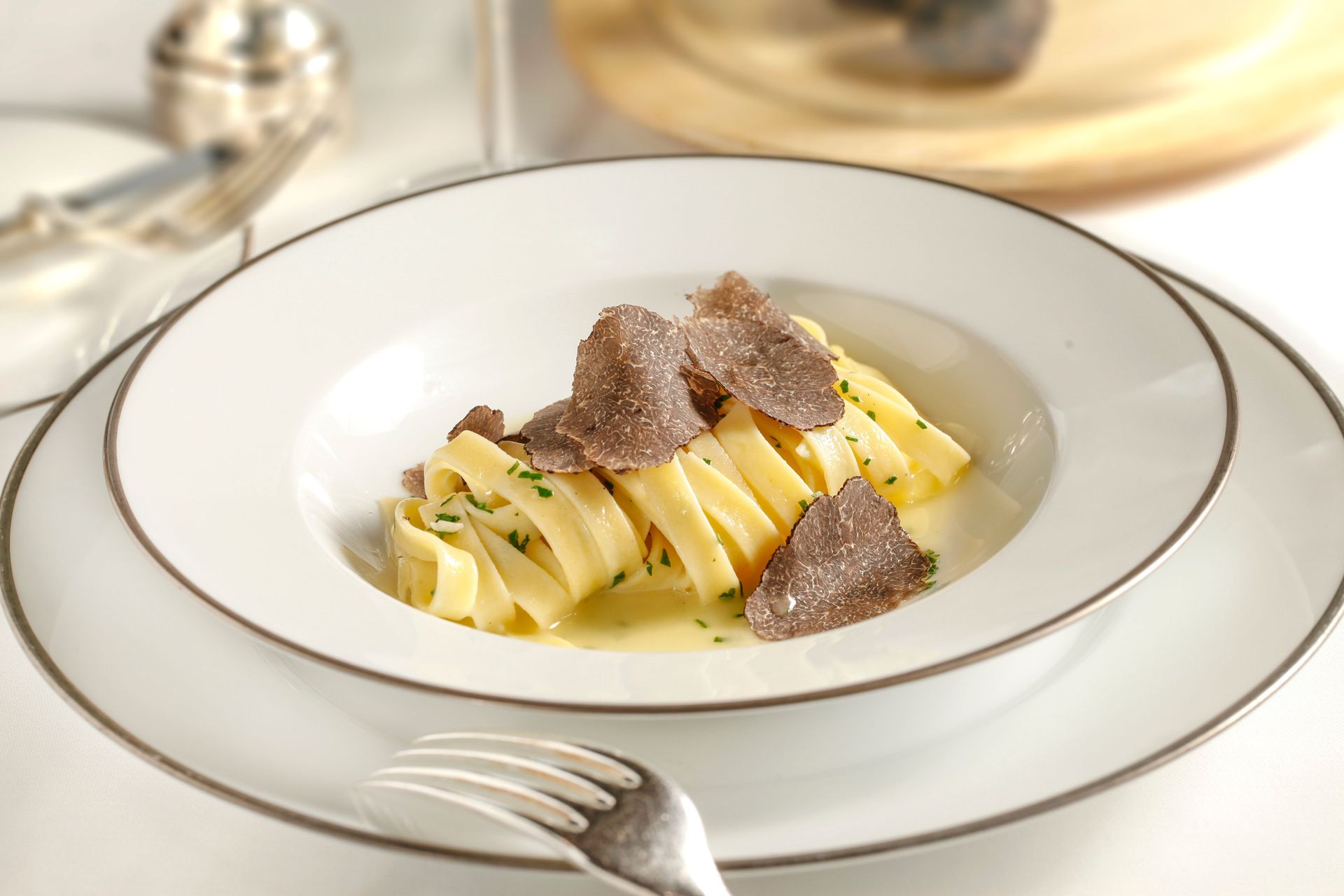
The truffle is not cooked. It is shaved raw, at the table, over something warm and deliberately plain: tajarin with butter, a fried egg, a plate of raw Fassona beef, a risotto. Anything more complicated is competing with it.
It is weighed in front of you before it is shaved, and it should be. The price is by the gram and it moves week to week with the rain a wet October brings the price down, a dry one sends it up. Any figure published in August would be wrong by October, which is why there isn't one in this article.
The best version of this meal is not in a restaurant at all. It is in a private house or a rented villa, with a chef who has bought the tuber that morning at the market in Alba, and no other table in the room.
Planning it
How long. Three nights minimum, four is better. Two nights means you will spend one of them recovering from the drive and the other at the fair, and you will not have seen the Langhe at all.
When to book. Now, if you are travelling in October or November. The houses worth renting in Barolo and Monforte are committed by mid-September, and the drivers who know these roads in fog are committed earlier than that.
Getting there. Alba is roughly an hour from Turin by car and about two from Milan, on good roads. There is no useful train. A private driver is not a luxury here but a practical necessity: the ridge roads are narrow, unlit, and in November they are in cloud. Helicopter transfers are possible from Milan and are occasionally the right answer when the trip is short though the same fog that makes the region beautiful will ground them without warning.
What to expect of the weather. Cold mornings, mild afternoons, and rain. Bring the coat you would bring to London in November, and proper shoes: the woods are mud from the middle of October.
Autumn is the Langhe's real season, and it is short. If Piedmont is on your list for this year, the decision needs to be made in the next two or three weeks not because of the fair, but because everything worth having in the region is arranged privately, and privately arranged things run out first.
Italy First Class accepts a limited number of requests each year. If you are considering Piedmont this autumn, tell us what you have in mind.
Related: Venice Without the Crowds and How to Plan a Luxury Trip to Italy.
Common questions
When is white truffle season in Alba?
The white truffle harvest in Piedmont runs from 1 October to 31 January. The Fiera Internazionale del Tartufo Bianco d'Alba takes place from 10 October to 6 December 2026. The best combination of quality, colour in the vineyards and manageable crowds falls between late October and early December.
Is truffle hunting with a dog authentic, or staged for visitors?
Both exist. Most experiences sold online are demonstrations, held at a convenient hour in an enclosed wood with a truffle placed in advance. A genuine search happens before dawn or after dark, is led by a trifolau in his own ground, and may find nothing at all. The genuine version has to be arranged privately and in advance, and cannot be guaranteed to produce a truffle.
How many days do I need in the Langhe?
Three nights is the practical minimum and four is better. Two nights leaves time only for the drive and the fair, without seeing the villages, the cellars or the ridge roads that are the real reason to come.
How much does white truffle cost?
The price is set by the gram and changes week by week with rainfall: a wet autumn lowers it, a dry one raises it sharply. Any figure quoted months in advance will be wrong. The truffle should always be weighed in front of you at the table before it is shaved.