

The Underground Cathedrals of Canelli (Unesco)
The Underground Cathedrals of Canelli (Unesco)
Ask a well-travelled guest which town in Piedmont has more history below the street than above it, and Canelli will not come up. Most people who have driven through the Moscato hills of Asti on their way to the Langhe have never had a reason to stop there, and the ones who did probably parked, had a coffee, and left without knowing what was under their feet.
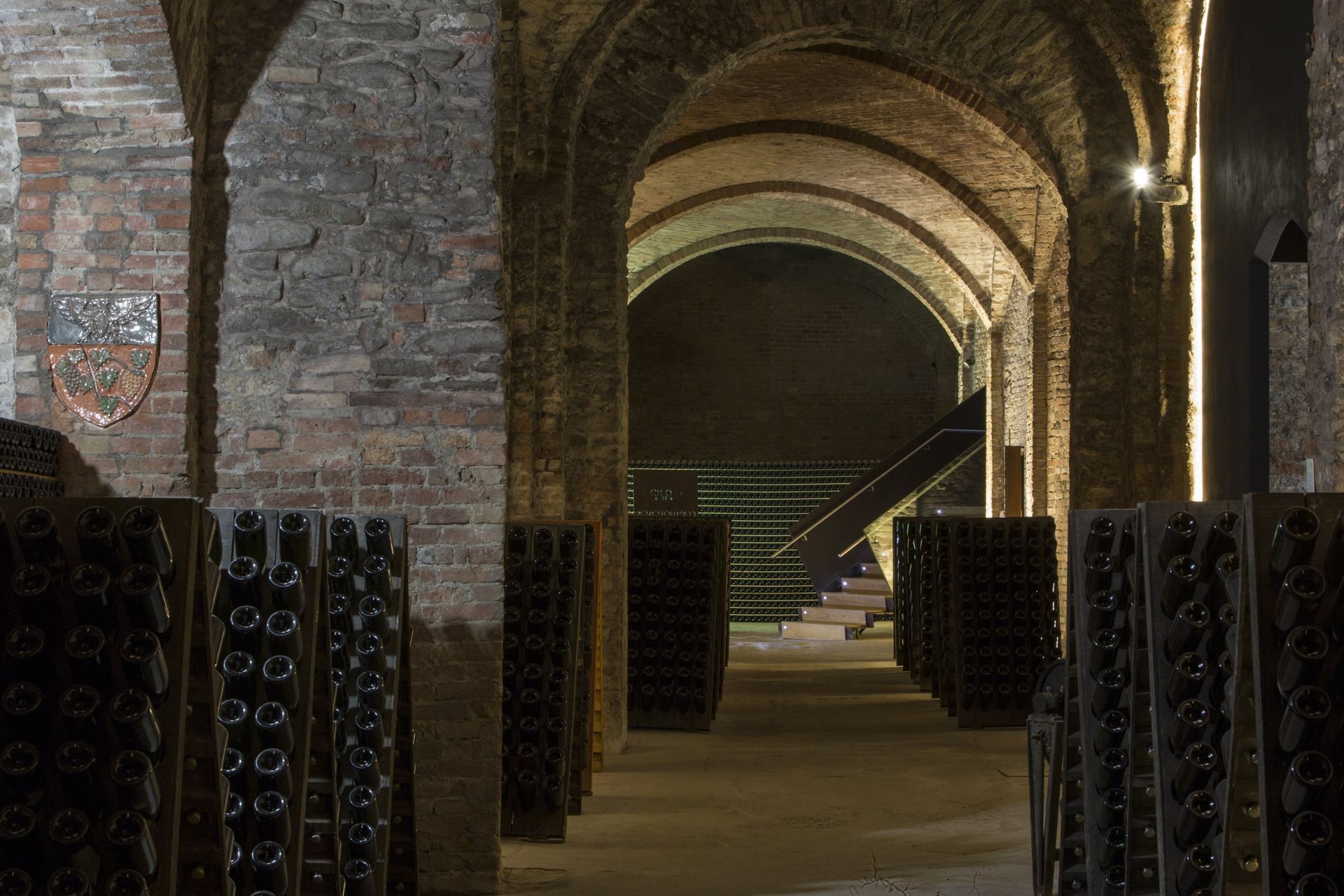
Under the centre of Canelli, four historic wine houses have carved more than twenty kilometres of galleries into the soft tufo rock, some of them reaching thirty metres and more below the surface. Locals call them cattedrali sotterranee, the underground cathedrals, and the name is not a flourish invented for a brochure. It is what the town has called them for over a century.
This is where Italy's first sparkling wine was put to rest on its lees in 1865, and where the country's most serious Metodo Classico still ages today, at a constant twelve to fourteen degrees, in near total silence, under a town most people drive past on the way to somewhere else.
A UNESCO site with no single postcard
In June 2014, UNESCO inscribed the Vineyard Landscape of Piedmont: Langhe-Roero and Monferrato as Italy's fiftieth World Heritage Site, and the first anywhere in the world dedicated entirely to a wine culture rather than a single monument or town. Most visitors picture it as the Langhe's ridgelines above Barolo and Barbaresco: rows of nebbiolo climbing a hill, a castle on top.
The inscription actually covers six separate zones, and one of them is not a landscape you look at from a terrace. It is a landscape you walk into. Canelli and its underground cellars form one of the six core areas, alongside the Langa di Barolo, the Colline del Barbaresco, the castle of Grinzane Cavour, Nizza Monferrato, and the small rock-cut infernot cellars of the Monferrato degli Infernot. Most guests who ask us about Piedmont's UNESCO status have heard of the hills. Almost none have heard of the tunnels.
What is actually down there
Four historic houses hold the galleries: Bosca, Contratto, Coppo and Gancia, each with its own network, cut independently into the same tufo hillside and now loosely connected below the town. Combined, the four run to more than twenty kilometres of tunnel, room and vaulted hall. Coppo's own section alone covers over five thousand square metres, and its deepest gallery reaches close to forty metres underground.
The rock is tufo, a soft calcareous stone that cuts easily when first exposed to air and hardens with time, which is why builders could carve wide rooms with brick-vaulted ceilings rather than simple tunnels. Some of the earliest of these rooms, at Coppo, began in the eighteenth century as small storage cellars, long before anyone in Canelli had made a sparkling wine. They were widened and connected room by room across the nineteenth and twentieth centuries, which is why walking through one house's galleries can feel like walking through three different centuries without a wall between them.
A visit usually starts with a stone staircase down into air that is noticeably cooler and heavier than the street above. The corridors are lined with racks of bottles resting neck-down, each one turned a fraction of a degree every so often to work the sediment toward the cork, a step called remuage that a Metodo Classico wine needs after years spent fermenting a second time inside the bottle. The temperature never moves: twelve to fourteen degrees, all year, with a humidity the surface cannot hold, and that stillness is doing real work. Any vibration or swing in temperature disturbs the slow, sediment-settling process the wine is halfway through.
Older than the wine that made it famous
The story usually told about Canelli begins with one man. Carlo Gancia studied oenology as a young man and travelled to Reims to learn the Champagne method directly. He came home to Canelli and in 1865 produced the first Italian bottle-fermented sparkling wine, working with the Moscato grape that already grew across these hills. It was, in effect, Italy's introduction to what the French called méthode champenoise, and it is why Canelli is sometimes called the birthplace of Italian spumante.
It is a clean story, and like most clean stories it leaves out the part that complicates it. The tunnels Gancia used were not built for his wine. Parts of them, as Coppo's own history shows, were already cellars decades before 1865, dug to keep produce and barrels cool underground in a town with no other way to do it. What 1865 changed was the use, not the place. The cathedrals are older than the wine that made them famous, and the wine simply found a home that had already been waiting for it.
What ages there now
The galleries no longer age only sweet Moscato. Alta Langa DOCG, the region's dry Metodo Classico and the most serious sparkling wine Piedmont makes, rests on its lees down there for years at a time, undisturbed by light or a change of season it would notice on the surface. Some houses use the same rooms for still wine too: Barbera d'Asti, Nizza DOCG, even Barolo brought in from further west to finish its ageing somewhere colder and quieter than a cellar can be above ground.
None of it is staged for visitors. The bottles stacked along a gallery wall are working stock, not a display, and a house will move a tour out of a room without apology if that day's work needs it.
What you can see, and what you cannot
Of the four houses, three, Bosca, Contratto and Coppo, open parts of their galleries to visitors, always by appointment and never on short notice. Gancia's own network, the one tied directly to the 1865 story, is not currently open to the public. If that particular name is the reason you want to come, that door is closed for now.
Most of the twenty kilometres under the town is not open to anyone outside the four houses either. What is shown on a visit is a fraction of it: the rooms built for people to walk through, not the working sections still used for storage and refinement. A good guide will tell you this plainly if you ask.
September is the wrong month to expect much flexibility. It is harvest, the Moscato and Barbera grapes are coming in, and the same houses that might show you their galleries in April are pressing grapes and moving barrels right now. We build Canelli into a Piedmont itinerary around the crush, not through it: late spring or October, once the tanks have gone quiet, is when a visit actually gets the time it deserves.
Planning it
How it fits. Canelli is not a destination on its own. It sits about forty minutes from Asti and just over an hour from Alba, close enough to combine with a Langhe or Monferrato itinerary as a half-day rather than a place to sleep.
When to go. Outside the September and early October harvest, when the houses can give a visit proper time. Spring and late October both work well. The underground temperature never changes, so unlike the vineyards above it, Canelli has no bad season, only a busier one.
Getting there. By car from Asti or Alba on ordinary roads, under an hour either way. Canelli has its own train station, but connections from Turin or Milan are slow enough that a private driver remains the sensible choice for a half-day detour.
Booking. None of the four houses take walk-ins for the galleries. A visit needs to be requested days, sometimes weeks, ahead, longer still around the harvest.
Canelli will not be the headline of anyone's trip to Piedmont. It was never built to be one. That is closer to the reason it is worth the detour: a town that has spent a hundred and sixty years quietly keeping Italy's most serious sparkling wine in the dark and the cold, without needing anyone to notice.
Italy First Class accepts a limited number of requests each year. If Piedmont is part of your plans, tell us what you have in mind.
Related: White Truffle Season in the Langhe and How to Plan a Luxury Trip to Italy.
Common questions
What are the underground cathedrals of Canelli?
They are more than twenty kilometres of galleries cut into the tufo rock beneath the town of Canelli, in the Asti province of Piedmont, held by four historic wine houses: Bosca, Contratto, Coppo and Gancia. They form part of the UNESCO World Heritage site Vineyard Landscape of Piedmont: Langhe-Roero and Monferrato, inscribed in 2014.
Can you visit the underground cathedrals of Canelli?
Three of the four houses, Bosca, Contratto and Coppo, open sections of their galleries by appointment. Gancia's own network is not currently open to the public. Visits are not possible on short notice and are hardest to arrange during the September harvest, when the houses are working, not hosting.
Why is Canelli part of a UNESCO wine site?
In June 2014, UNESCO inscribed the Vineyard Landscape of Piedmont: Langhe-Roero and Monferrato as Italy's fiftieth World Heritage Site. Canelli and its underground cellars form one of the six recognised zones, alongside the hills of Barolo, Barbaresco, Grinzane Cavour, Nizza Monferrato and the Monferrato degli Infernot.
What is aged in the Canelli cellars today?
Alongside the Moscato that made Canelli's name in 1865, the galleries now age Alta Langa DOCG, the region's dry Metodo Classico sparkling wine, and still wines including Barbera d'Asti and Nizza DOCG, kept at a constant twelve to fourteen degrees year round.